So, You Want to DIY Your Copy
DIY Copywriting for Small Businesses: Start With Your Brand Voice
As AI use has grown, many people are playing with their new robots to work faster and more efficiently. Small businesses are our bread and butter, so we totally understand tight margins and DIYing where you can. But you have to start with a strong foundation.
It begins (and ends, quite frankly) with your brand voice.
Before you ask ChatGPT to write your website copy or draft your next email campaign, you need to know how your business talks. You also need to know who you’re talking to, but that’s probably a conversation for another day. Without clarity around HOW you talk, you're going to create generic content that sounds like everyone else—or worse, sounds like a robot trying to sound human.
Why Brand Voice Matters for Small Business Copywriting
Your brand voice is your company's personality expressed through words. It's what makes your coffee shop/acupuncture clinic/mobile IV business sound different from the one down the street, even if you're both selling lattes/cupping/a Meyer’s Cocktail. It’s what makes people experiencing you online before experiencing you IRL want to experience you IRL.
Think of brand voice as your business's DNA. It stays consistent whether you're writing an Instagram caption, responding to a customer email, or updating your about page. And when you're a small business owner wearing all the hats, that consistency is what builds trust and recognition with your audience.
Many small businesses try to write copy before they know what their voice is. They jump straight into "we need a website" or "we need social media posts" without first answering the fundamental question: How does our business talk?
The Problem With AI-Generated Copy (Without Direction)
AI tools like ChatGPT are incredible for speeding up the writing process. We're not anti-AI. But AI is only as good as the direction you give it. If you tell ChatGPT "write an about page for my functional medicine practice," you'll get generic healthcare copy that could belong to literally anyone.
But if you can tell AI "write this in a warm, conversational tone that sounds like a knowledgeable friend explaining complex health topics over cappuccinos, avoid medical jargon, use 'you' language, and include questions to engage the reader"—now you're getting somewhere.
The difference? You know your brand voice.
How to Build Your Brand Voice (Before You Write Anything)
Building your brand voice doesn't have to be complicated, but it does require some intentional thinking. At Popa & Associates, we take every client through a comprehensive brand voice questionnaire before we write a single word for them. We ask questions like:
If your business were a person, who would they be?
What greetings does your brand use?
Does your brand like emojis?
What three adjectives describe your brand's personality?
Who would be your brand's spokesperson if you could pick anyone (dead or alive)?
These questions might feel silly at first, but they're essential. Because once you can answer them, you can write copy (or direct AI to write copy) that truly sounds like you.
We've written a ton about how to build your brand voice, including the difference between brand voice (your permanent personality) and brand tone (how you adapt that personality for different situations). If you're serious about DIY copywriting, that's required reading.
Image courtesy of Hana Kennedy on Dupe Photos
Your DIY Brand Voice Toolkit
For small businesses ready to tackle their own copywriting, we created a Brand Voice Guide questionnaire that walks you through the same process we use with our copywriting clients.
This $35 guide includes the questionnaire we use at P&A, plus a template for documenting your brand voice in a way you can reference every time you sit down to write. Think of it as your "how my company talks" Bible—something you keep handy for social media captions, blogs, website pages, email marketing, and anywhere else you're communicating as your business.
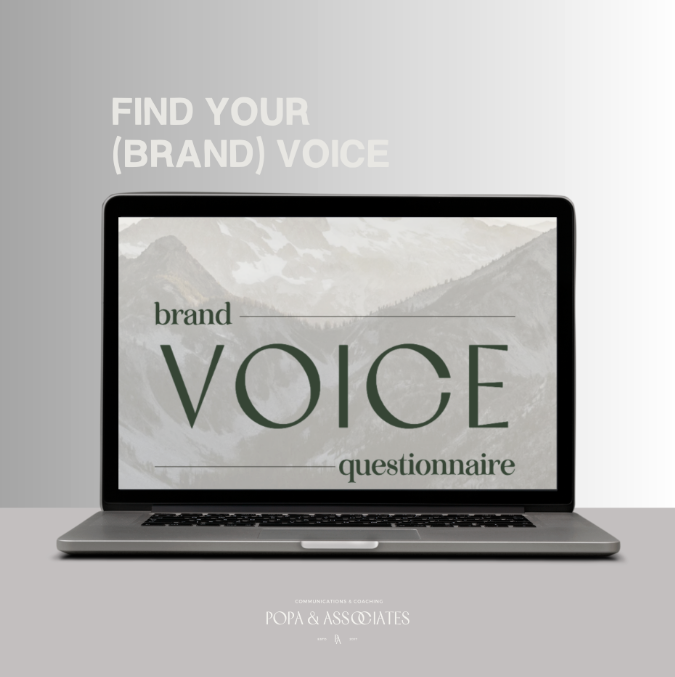
We recommend filling it out by hand first. Writing by hand helps you connect with your brand's personality in a way typing on a laptop doesn't quite capture (and there’s evidence to support memory recall around it). Once you've worked through the guide, you can digitize it (using AI, which you can also ask to remember your voice for the future) and keep it in your brand kit.
What You Can Do With a Strong Brand Voice
Once you know your brand voice, everything gets easier:
Writing your own copy becomes faster because you're not starting from scratch every time—you know how you sound.
Hiring help becomes simpler because you can hand your voice guide to a copywriter, designer, or virtual assistant and say, "This is how we talk."
Using AI becomes more effective because you can give specific direction: "Write this in our warm, slightly irreverent voice that uses questions to engage readers and always leads with empathy."
Your marketing feels cohesive because your Instagram captions, website copy, and email newsletters all sound like the same business.
The Reality of DIY Copywriting
You can absolutely DIY your copywriting. You know your business better than anyone. You have stories and insights that no copywriter (and definitely no AI) could come up with on their own.
But you need to start with the foundation. You need to know your brand voice before you write a single word.
Skip this step, and you'll spend hours staring at a blank screen, rewriting the same paragraph five times, or feeding AI prompt after prompt, trying to get it to sound right. Do this step well, and suddenly writing copy—or directing someone else to write it—becomes infinitely easier.
Start Here
If you're ready to DIY your copywriting the right way, start with your brand voice. Grab our Brand Voice Guide, pour yourself something delicious, and spend thirty minutes getting clear on how your business talks.
Once you have that clarity, everything else—the website copy, the social captions, the email campaigns—falls into place. You're no longer guessing. You know exactly how you sound.
And if you get through the questionnaire and realize you want help bringing that voice to life across your website, blog, or marketing materials? We're here for that, too.
Oh, and P.S., we’ve found that many people who DIY their copy with AI come to us for help. There is no shame in that. Honestly, it’s one of our favorite things to do. We’d be happy to set you straight and get you on the best DIY copy path for you. Just reach out!